 Contango
 Flash Loans, DeFi Leverage and Yield Strategies
Updated on
Contango is a DeFi protocol that combines flash liquidity, token swaps and collateralized lending to construct leveraged positions within one transaction. Its v2 model supports directional trading, leveraged staking exposure and yield strategies, including Pendle Principal Tokens. The selected lending market determines collateral requirements, borrowing costs and liquidation conditions.
What remains after the flash loan?
The completed position contains supplied collateral and ongoing debt on a lending market. Temporary liquidity makes construction possible before the full collateral position exists. After execution, interest and collateral requirements continue while the borrowing remains. Repaying or settling the flash financing does not erase that ongoing debt. A single atomic transaction can therefore create a position needing continued monitoring.
Margin and position construction
Margin is the capital committed to a leveraged position. The base asset is the asset the position goes long or short, while the quote asset expresses its relative price. These roles determine which asset becomes collateral and which asset the position owes, explaining why the currency supplied as margin matters.
Long positions
Quote-currency margin
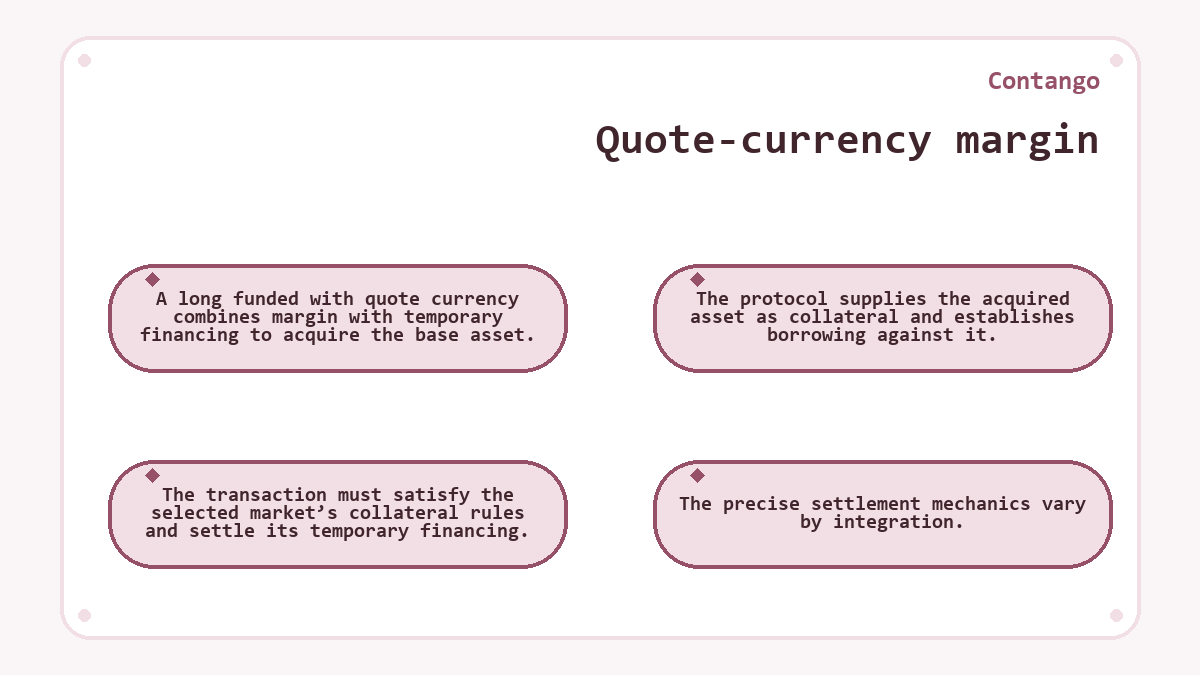
A long funded with quote currency combines margin with temporary financing to acquire the base asset. The protocol supplies the acquired asset as collateral and establishes borrowing against it. The transaction must satisfy the selected market’s collateral rules and settle its temporary financing. The precise settlement mechanics vary by integration.
Base-asset margin
Base-asset margin already contains the asset the long position will supply. That portion can join the collateral directly, alongside additional base assets acquired through the leveraged trade. Quote-currency margin needs conversion into the base asset, while entering with another currency available in the trade ticket can require additional swaps.
Short positions
Short positions have borrowed base-asset exposure and supplied quote-asset collateral. A rise in the base asset’s relative price increases the value of the debt. The v2 short construction retains a liquidation boundary even at displayed leverage of 1x.
Earlier expirable markets
The v1 expirable product used fixed-rate borrowing and lending and was sunset in late 2023. The v2 looping model uses variable-rate money markets. Historical v1 maturity and settlement rules belong to that earlier product.
How does the lending market determine liquidation risk?
Liquidation risk depends on the selected money market’s collateral rules, outstanding debt and oracle valuation. Loan-to-value, or LTV, relates debt value to collateral value, and opening limits can differ from liquidation thresholds. Where a market does not distinguish them, Contango applies an opening buffer whose size can differ by instrument. Liquidations take place on the underlying money market. Its liquidation penalties also apply.
The mark price is the oracle valuation the selected lending market uses. An execution quote describes the price available through a trading route. Charts can use a price feed from another chain and need not match that market’s oracle. Adverse price changes or accumulating borrowing costs can weaken collateral coverage even when an indicative chart appears reassuring.
Contract exposure extends across the core protocol, the selected lending market and the assets involved. Audits cover the core contracts and integrations, while some contracts used only to display information remain unaudited. Upgrade permissions also leave administrative dependencies. An audited integration does not remove vulnerabilities in an underlying asset or market.
Funding rates and return on equity
Lending income and borrowing expenses produce the position’s implied funding rate, which the app displays as APY, or annual percentage yield. A positive reading represents net interest income; a negative reading represents a carrying cost. Rates can change when market utilization moves, including when a position’s own borrowing and lending affect that utilization.
ROE, or return on equity, expresses returns relative to initial margin, whereas the funding APY uses the position’s notional value. These denominators explain why the displayed percentages differ. Funding accrues within profit and loss and settles when a position closes partially or fully. Price movements and execution costs also affect the amount ultimately received.
Rate-arbitrage strategies can combine offsetting exposures to pursue a difference in funding rates. Supported stablecoin pairs offer another route through interest-rate spreads, with peg deviations and changing borrowing costs affecting returns.
Service fees and execution liquidity
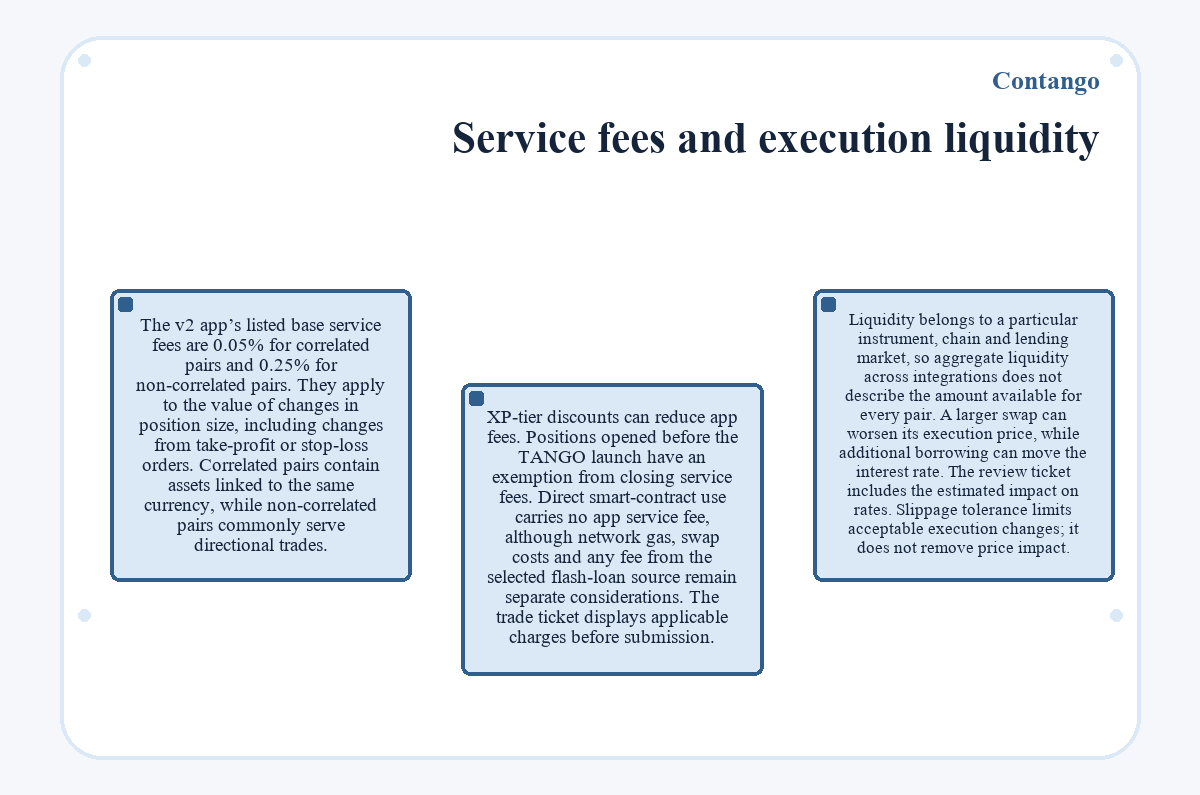
The v2 app’s listed base service fees are 0.05% for correlated pairs and 0.25% for non-correlated pairs. They apply to the value of changes in position size, including changes from take-profit or stop-loss orders. Correlated pairs contain assets linked to the same currency, while non-correlated pairs commonly serve directional trades. XP-tier discounts can reduce app fees.
Positions opened before the TANGO launch have an exemption from closing service fees. Direct smart-contract use carries no app service fee, although network gas, swap costs and any fee from the selected flash-loan source remain separate considerations. The trade ticket displays applicable charges before submission.
Liquidity belongs to a particular instrument, chain and lending market, so aggregate liquidity across integrations does not describe the amount available for every pair. A larger swap can worsen its execution price, while additional borrowing can move the interest rate. The review ticket includes the estimated impact on rates. Slippage tolerance limits acceptable execution changes; it does not remove price impact.
Directional positions and hedging
Directional positions express exposure to the base asset against its quote asset. A long benefits from an increase in that relative price before costs; a short benefits from a decline. Shorts can also offset part of an existing asset holding’s price exposure. Such a hedge retains borrowing expenses and its own liquidation boundary, so offsetting price exposure does not create a fixed return.
Leveraged staking exposure and Pendle PTs
Liquid staking and restaking loops increase exposure to supported yield-bearing assets, including wstETH and eETH, using borrowing. Their economics combine the asset’s yield with financing costs. Related asset prices can move apart, and changes in the underlying staking or restaking arrangement affect the collateral’s risks. Available leverage and liquidity depend on the selected lending market.
Principal Tokens and maturity
Pendle Principal Tokens, or PTs, represent the principal portion of a yield-bearing asset. At maturity under normal redemption conditions, one PT delivers value equal to one unit of its specified accounting asset, which can differ from the original yield-bearing token. Redemption can fall below that value if the underlying exchange rate is below its recorded watermark.
PT looping combines fixed-yield exposure with variable borrowing costs, while entry costs and exit liquidity also affect the outcome. An early sale receives the market price available then. PT maturity does not automatically close the v2 position, and debt continues accruing interest after the PT stops earning its maturity-related yield.
Underlying incentives and TANGO staking
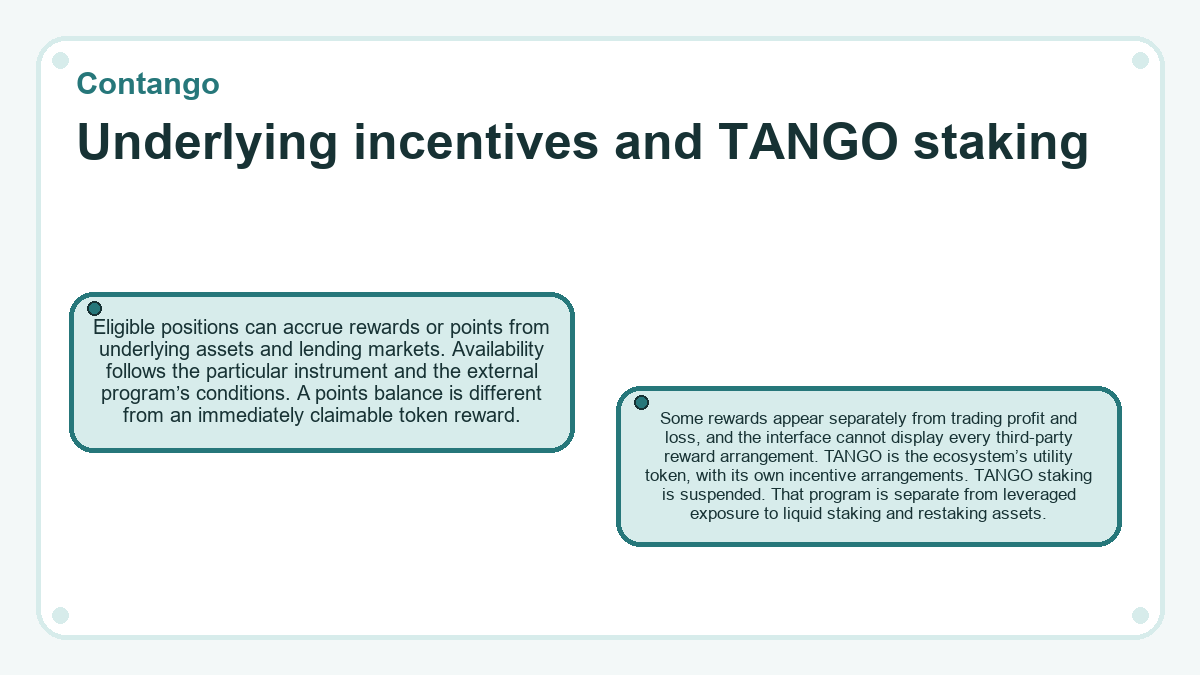
Eligible positions can accrue rewards or points from underlying assets and lending markets. Availability follows the particular instrument and the external program’s conditions. A points balance is different from an immediately claimable token reward. Some rewards appear separately from trading profit and loss, and the interface cannot display every third-party reward arrangement.
TANGO is the ecosystem’s utility token, with its own incentive arrangements. TANGO staking is suspended. That program is separate from leveraged exposure to liquid staking and restaking assets.
Advanced, Simplified and direct access
The Simplified and Advanced interfaces create the same kind of looped lending-market position. Simplified groups selected strategies for browsing, while Advanced exposes more pair-selection and position-management controls, including automated orders. Positions opened through Simplified also appear in Advanced. Direct contract interaction provides another access route for those able to construct the required calls.
| Access method | What the route requires |
|---|---|
| Simplified interface | Margin for a displayed strategy and sufficient liquidity in its selected market. |
| Advanced interface | Margin for a supported pair, with its chain and lending market selected. |
| Direct contract calls | Correct contract calls satisfying the target market’s collateral and liquidity requirements. |
Documented integrations include Aave, Compound, Morpho, Spark, Silo and Dolomite. Actual pair availability depends on supported collateral and borrowing combinations. The ticket’s balance refers to its selected currency and chain. Connecting a wallet on another network does not establish a usable balance for that trade.
Position controls and manual looping
Take-profit and stop-loss orders use keeper bots through the Advanced interface, with execution dependent on available liquidity, transaction submission and functioning keepers. Fast price changes or excessive slippage can prevent a fill. The documented v2 automated-order rules allow 20% slippage relative to the trigger price, which is therefore not a promised execution price. A price breaching the adverse-slippage limit leaves the order unexecuted and canceled.
Keeper execution adds a reward covering gas costs alongside applicable trading fees. Spot-swap operations also face transaction-ordering attacks, including sandwiching. A protected RPC can reduce that exposure on Ethereum mainnet. The market’s oracle governs liquidation eligibility separately from whether an automated closing order successfully executes.
Manual looping involves repeated lending, borrowing and swapping to build exposure, whereas Contango coordinates those operations through automated execution and a trading interface. Both approaches leave collateral and debt subject to the chosen lending market. Automating construction changes the execution work; it does not make variable borrowing costs predictable.
Questions people ask about Contango
-
Can I keep several positions on the same pair?
- Contango’s force-open option permits separate positions on the same pair and direction. Without it, a new trade on an existing instrument normally adds to the existing position. With force-open enabled, an opposite-direction position can remain separate instead of offsetting an existing position.
-
How can a position move to another wallet?
- A position moves through transfer of the NFT representing it. The receiving address gains the position and its associated on-chain rewards, while the position’s transaction history does not import into that address’s interface. Off-chain points and rewards follow each external program’s tracking rules and may remain split between addresses.
-
Does repaying debt require selling the collateral?
- A leveraged long can reduce debt through additional capital while keeping its asset position size unchanged. This differs from reducing leverage through a smaller total position. The required contribution depends on the position’s debt and the intended adjustment.
-
Which currency can I receive when closing manually?
- Manual closing offers the cashflow currencies available in the closing ticket’s dropdown. Selecting a different output asset can require conversion and introduce additional execution costs. Automated take-profit and stop-loss closures have a separate rule: their cashflow arrives in the quote currency.
-
Why can a new position start with negative PnL?
- Opening costs and the spread between buying and selling can put an otherwise unchanged position into negative profit and loss. Leverage makes those costs larger relative to margin. The price source used for displayed PnL can also differ from an executable closing quote.
-
Are token approvals part of the single-transaction claim?
- The single-transaction description concerns position construction, while token spending permissions may require a separate on-chain approval. Where supported, a permit uses an off-chain signature and applies the allowance during the position transaction. Token and wallet compatibility determine which authorization methods are available.
-
What determines whether a strategy appears in Simplified?
- Simplified displays a filtered selection subject to liquidity requirements, rather than every pair available through Advanced. Asset, chain and market filters affect that selection. The entered investment amount and return filters can also change the displayed strategies and their estimated returns.
-
Is migration to another lending market free?
- A supported market migration has no Contango migration service fee, although network gas and any applicable flash-loan fee can remain. The documented migration mechanism does not require a spot swap, so it avoids swap fees. Availability still depends on an eligible destination market.