 Contango
 Pricing: Oracle Values Versus Trade Quotes
Updated on
Contango uses lending market oracles to assess liquidation risk and spot quotes to price token trades. The mark price reflects the selected lending market’s valuation. The execution quote reflects available spot liquidity, while the price source selected for an open position affects its displayed profit or loss.
Bottom line: Changing the displayed PnL source changes the estimate you see, while the underlying money market retains its liquidation rules.
Oracle valuation inside the lending market
An oracle price supplies an asset valuation a lending market uses to assess a position’s health. The mark price in the trading interface reflects that valuation. The underlying money market uses its oracle valuation to determine liquidation eligibility.
Collateral and debt limits
Loan-to-value (LTV) limits constrain borrowing against collateral, while liquidation thresholds govern when an existing position becomes eligible for liquidation. These limits belong to the selected lending market. A spot quote answers a different question: what price is available for the proposed swap. A position can therefore have different values for collateral assessment and immediate sale. Changing the displayed profit and loss (PnL) source leaves the market’s collateral rules in place.
Market rate and exchange rate feeds
A market rate feed reports secondary-market pricing. An exchange rate feed reports a protocol’s internal exchange or redemption relationship. Each lending market chooses the feed it uses. A temporary discount on spot markets can affect liquidation eligibility where the relevant oracle follows market prices. A redemption-based valuation can consequently differ from the price available for selling the collateral.
Price sources and display limits
Open-position exit pricing offers Money Market Oracle, Contango Price Service and DEX Spot Market. The trade dialog and chart also show prices, with different roles. These displays describe collateral valuation, estimated proceeds or the proposed trade’s execution price.
| Pricing display or source | Scope and limitation |
|---|---|
| Money Market Oracle | Uses the selected lending market’s valuation; secondary-market proceeds can differ. |
| Contango Price Service | Queries additional price sources; a reliable alternative price may be unavailable. |
| DEX Spot Market | Provides a current spot-based exit estimate; excessive requests can trigger address-level rate limits. |
| Checkmarked quote in the trade dialog | Prices the proposed opening, modification or closure; applies to that particular trade. |
| Chart oracle price | Provides an indicative reference; need not match the selected lending market or chain. |
Why can the entry quote differ from the mark price?
The entry quote prices the proposed spot trade, while the mark price expresses the lending market’s collateral valuation. For a long position, an entry below the mark means a cheaper purchase relative to that valuation. An entry above the mark means the same quote-currency amount buys less collateral. The difference can affect whether the proposed debt satisfies the market’s LTV limit.
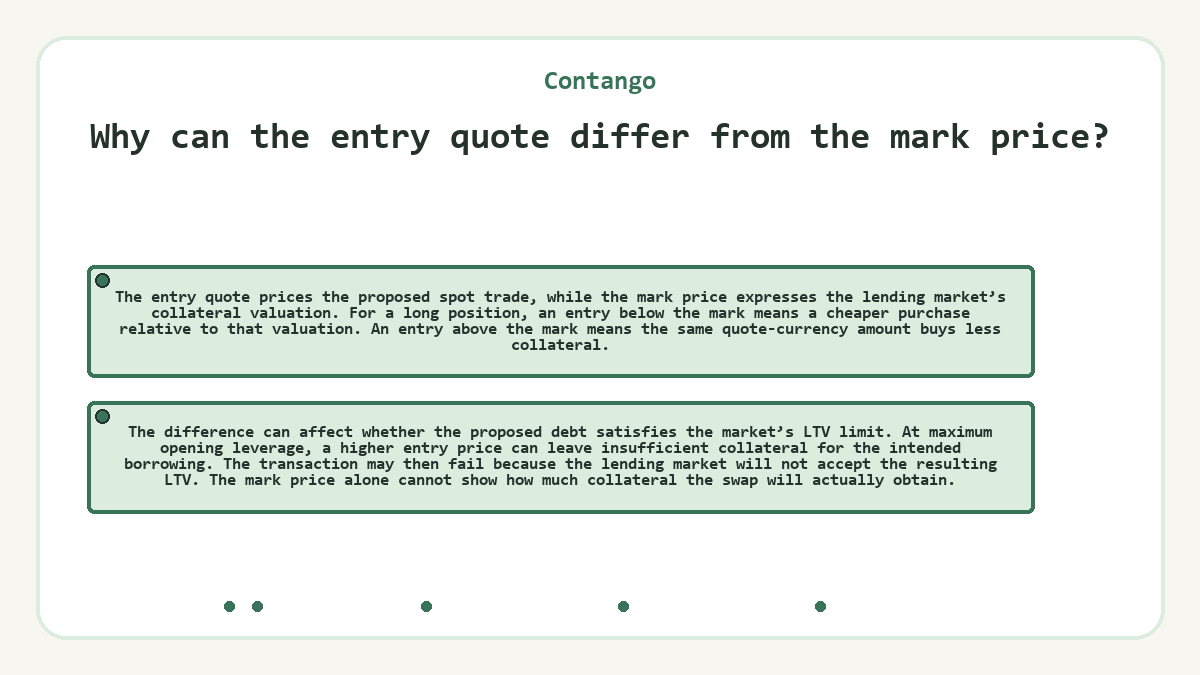
At maximum opening leverage, a higher entry price can leave insufficient collateral for the intended borrowing. The transaction may then fail because the lending market will not accept the resulting LTV. The mark price alone cannot show how much collateral the swap will actually obtain.
Which price gives a realistic exit estimate?
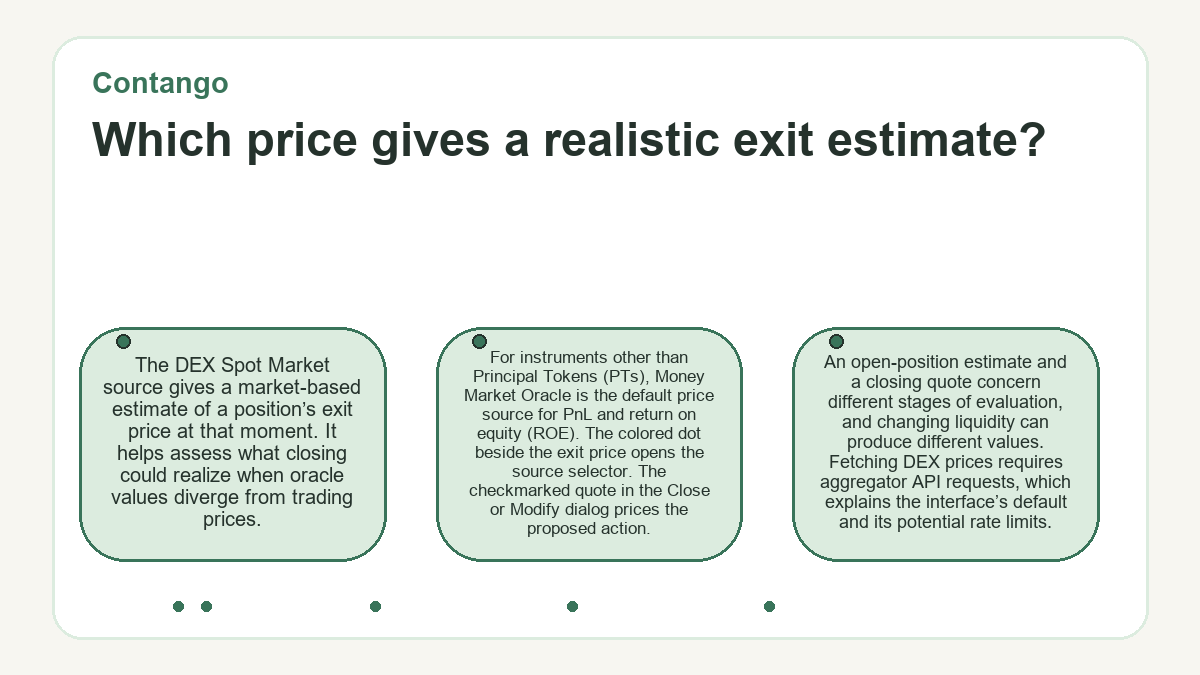
The DEX Spot Market source gives a market-based estimate of a position’s exit price at that moment. It helps assess what closing could realize when oracle values diverge from trading prices. For instruments other than Principal Tokens (PTs), Money Market Oracle is the default price source for PnL and return on equity (ROE). The colored dot beside the exit price opens the source selector.
The checkmarked quote in the Close or Modify dialog prices the proposed action. An open-position estimate and a closing quote concern different stages of evaluation, and changing liquidity can produce different values. Fetching DEX prices requires aggregator API requests, which explains the interface’s default and its potential rate limits.
Spot liquidity and execution tolerance
Spot execution depends on liquidity for the exact instrument and chain. The selected lending market also determines available borrowing liquidity. Aggregate protocol liquidity does not describe the depth available for every individual swap. Balmy aggregates spot routes when opening, modifying or closing a position requires a swap. Thin spot liquidity can produce a worse quote for a larger trade, even when the oracle valuation barely changes.
Price impact measures the effect of the trade’s size on the available swap price. Slippage tolerance limits the price movement accepted during execution, with controls available after Review trade. A tighter tolerance does not create liquidity or remove a spread already present in the quote. An oracle-based position value can consequently exceed the value obtainable through the available exit route.
Chart prices and service fallback
Charts show an indicative oracle price chosen for responsiveness. The chart need not represent the lending market holding the position.
Chart selection favors feeds with shorter update intervals and smaller deviation thresholds across chains. The chain supplying that reference can differ from the selected trading chain. A responsive chart can help show price movement, while the position’s mark price continues to reflect its own lending market’s oracle. Reading a liquidation boundary against the chart can therefore mix valuations from different contexts.
Contango Price Service queries additional sources, including Balmy and DefiLlama, to improve the displayed valuation. If it cannot find a reliable source, it falls back to the source used for chart pricing. The fallback shares the chart’s limitations as an indicative price, including its potential mismatch with the selected market.
PT valuation before and at maturity
PT instruments add a maturity value to the price comparison. Their purchase price and expected redemption value shape the displayed return. The borrowing leg remains variable, and a secondary-market exit can differ from the maturity outcome.
Entry price and projected ROE
PT opportunities initially use mark pricing to estimate ROE. Once trade details produce a firm entry quote, the interface recalculates the estimate using that price. An existing position reflects the PT yield implied by its actual purchase price, so its ROE can differ from a newly quoted opportunity. The projected outcome assumes holding to maturity, average borrowing rates remaining at the estimated level and no major exit price impact.
Redemption asset and exit price
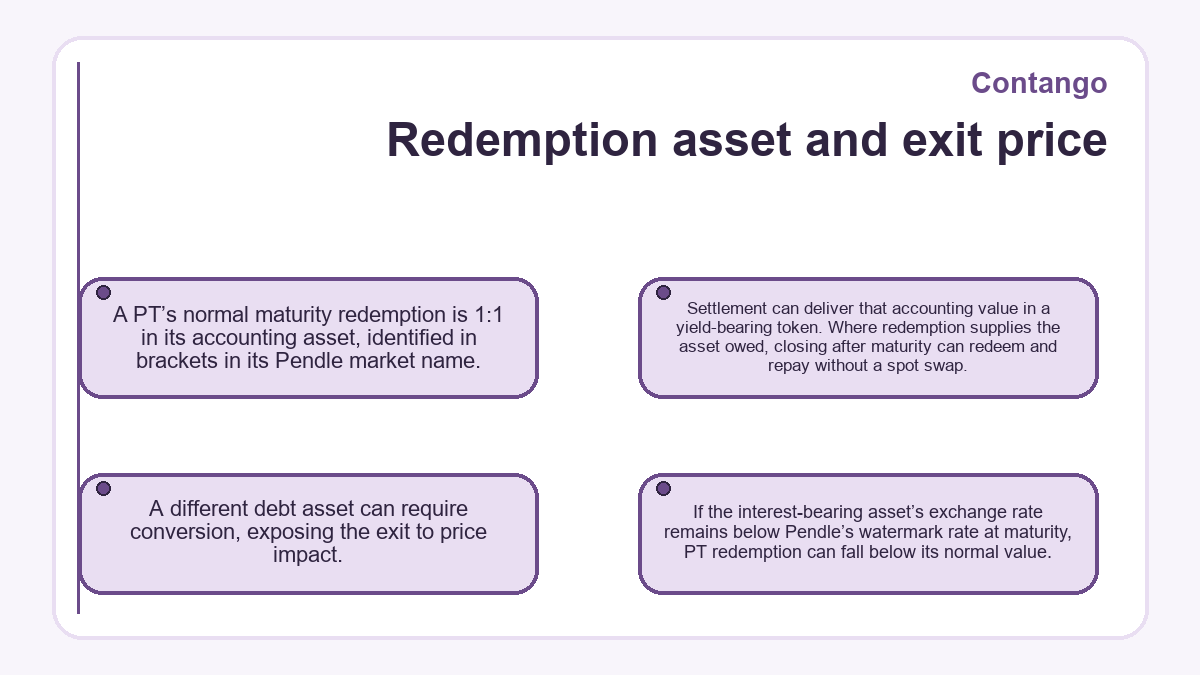
A PT’s normal maturity redemption is 1:1 in its accounting asset, identified in brackets in its Pendle market name. Settlement can deliver that accounting value in a yield-bearing token. Where redemption supplies the asset owed, closing after maturity can redeem and repay without a spot swap. A different debt asset can require conversion, exposing the exit to price impact. If the interest-bearing asset’s exchange rate remains below Pendle’s watermark rate at maturity, PT redemption can fall below its normal value.
Price estimates and financing costs
PnL combines price movement with accrued financing income or costs. Annual percentage yield (APY) expresses the lending-versus-borrowing cash flow relative to position notional. ROE expresses the return relative to initial margin, so identical percentages would refer to different capital bases. The funding component accrues within PnL and settles when the position closes partially or fully.
A positive annualized return estimate can coexist with a lower immediate exit valuation. Interest income accrues over time, whereas an exit uses the liquidity available then. Fees and execution costs also affect final proceeds. For PT positions, borrowing charges continue after maturity even though the matured PT no longer earns additional yield. A price quote alone cannot fix those financing costs for the position’s remaining lifetime.
Contango questions worth asking
How often do the trade ticket’s rate inputs refresh?
The opening ticket updates lending and borrowing rates every 60 seconds. Asset yield rates usually update every 24 hours, with updates every 60 minutes for Pendle PTs and Ethena assets. These refresh intervals concern rate inputs used in estimates; the checkmarked trade quote remains a separate spot-pricing value.
Can the proposed trade change the interest rates shown in its quote?
The proposed trade can change lending and borrowing rates through its effect on the underlying market. The market impact on rates metric in the trade ticket estimates that change for the chosen size. This effect concerns financing conditions, while spot price impact concerns swap execution. A favorable pre-trade yield can weaken when additional borrowing changes the market’s rates.
Are third-party rewards part of the displayed PnL figure?
Most rewards from the underlying lending market appear on an additional line, separate from the main PnL figure. Hovering over that line shows the accrued token quantity. Some third-party rewards cannot be displayed because their claiming processes differ.
Does a firm spot quote provide automatic protection against MEV?
A firm quote does not automatically protect a spot trade against maximal extractable value (MEV). Swaps can face sandwich attacks that worsen execution. On Ethereum mainnet, submitting the swap transaction through an MEV-protected RPC can reduce that exposure. Slippage tolerance separately limits the price movement a transaction accepts during execution.
What determines the penalty once a position becomes eligible for liquidation?
The underlying lending market sets the liquidation penalty for its positions. Contango does not carry out liquidations. The penalty applies to collateral purchased during that process, so it belongs to the market’s liquidation terms. A normal spot-trade quote prices a voluntary execution and does not describe that penalty.