 Contango
 funding rates reflect lending income minus borrowing costs at the chosen leverage
Updated on
Contango funding rates express lending income minus borrowing costs as annual percentage yield (APY) on position notional. Compare the same pair, direction, size and leverage across compatible markets. Positive APY means net financing income, while negative APY means a financing cost for the position.
A larger position can move lending and borrowing rates, so a funding comparison needs quotes for the intended trade size.
Eligible markets and matching exposure
Matching the pair, direction and leverage gives a funding comparison a common starting point. Position size and the selected chain also matter. Each quote belongs to a particular instrument on a particular lending market. Comparing across chains means comparing separate market conditions, even when the asset tickers match.
Available collateral and borrowing
A compatible market must accept the collateral, permit the required borrowing and have sufficient liquidity. Isolation mode can exclude otherwise available token combinations.
A shared leverage setting
Maximum opening leverage follows the selected instrument’s collateral rules. Markets can offer different maximums for the same exposure, so comparisons need a leverage both support. Using each market’s maximum changes debt relative to margin and obscures the financing difference.
The cashflows behind a positive or negative APY
Net financing comes from income on the supplied side minus interest owed on the debt. Those rates apply to different balances. Subtracting the displayed borrowing percentage directly from the supply percentage can therefore misstate the position’s net return. Both cashflows need a common value unit before they can form a net rate.
Lending and borrowing balances
A long ETH/USDC position combines ETH exposure with USDC financing. Its funding economics differ from a correlated wstETH/ETH loop, which combines staking-related return with ETH borrowing. These instruments serve different trading objectives, so their APYs do not measure the cost of identical exposure. Within either pair, the amounts supplied and borrowed determine the relevant cashflows.
A positive sign means income
A positive Contango APY indicates net financing income for the position. A negative APY indicates a cost of keeping it open. The sign describes the financing component. Price losses can exceed positive funding, and a profitable price move can outweigh a negative funding contribution.
Perp venues can use the opposite sign convention. Identify who pays and receives for the selected position before comparing signed funding figures.
APY on notional and ROE on margin
ROE, or return on equity, expresses the financing estimate relative to the position’s initial margin. Margin is the equity committed to the position; notional measures its market exposure. APY uses that notional as its denominator, so the percentages have different bases. APY helps compare funding for directional exposure; ROE helps interpret a correlated loop’s return on committed capital. Higher leverage changes both displays because it changes borrowing relative to margin. An annualized ROE also needs a holding period before it can describe an expected cash return.
| Rate parameter | Value or calculation boundary |
|---|---|
| APY sign | Above 0% means net financing income; below 0% means net financing expense. |
| APY calculation base | Position notional value. |
| ROE calculation base | Initial margin committed to the position. |
Trade size and the rate after entry
A larger position can alter the rates used to estimate its own funding cost. Added supply and borrowing change conditions in the underlying market. Equal leverage therefore leaves an important mismatch if the quotes use different position sizes.
The proposed trade’s rate impact
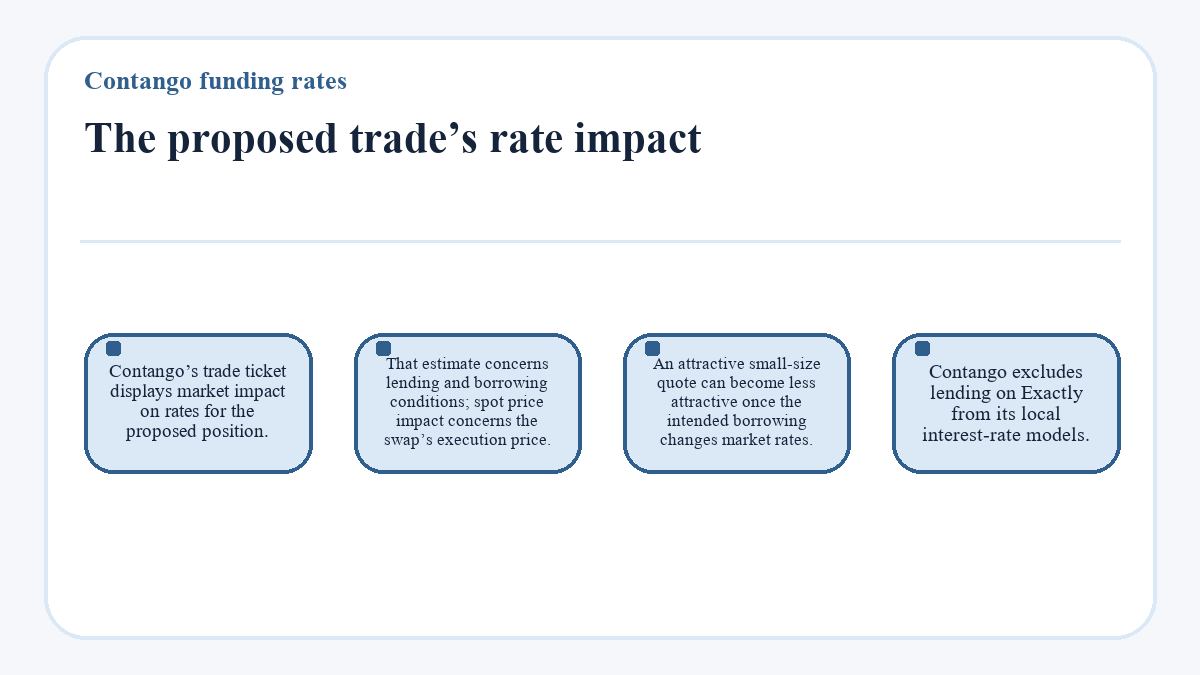
Contango’s trade ticket displays market impact on rates for the proposed position. That estimate concerns lending and borrowing conditions; spot price impact concerns the swap’s execution price. An attractive small-size quote can become less attractive once the intended borrowing changes market rates. Contango excludes lending on Exactly from its local interest-rate models.
Variable financing during the holding period
Contango’s implied funding rate varies with the lending and borrowing cashflows of the underlying market. An opening quote captures the conditions used for that estimate. Later market activity can alter financing income or expense. A favorable entry APY does not fix the rate throughout the position’s life.
A projected rate describes financing under the displayed conditions; accrued funding reflects the time the position has already remained open. Quotes taken at different moments can mix a market difference with a timing difference. Comparing them close together reduces that ambiguity.
Accrued funding and returns at closure
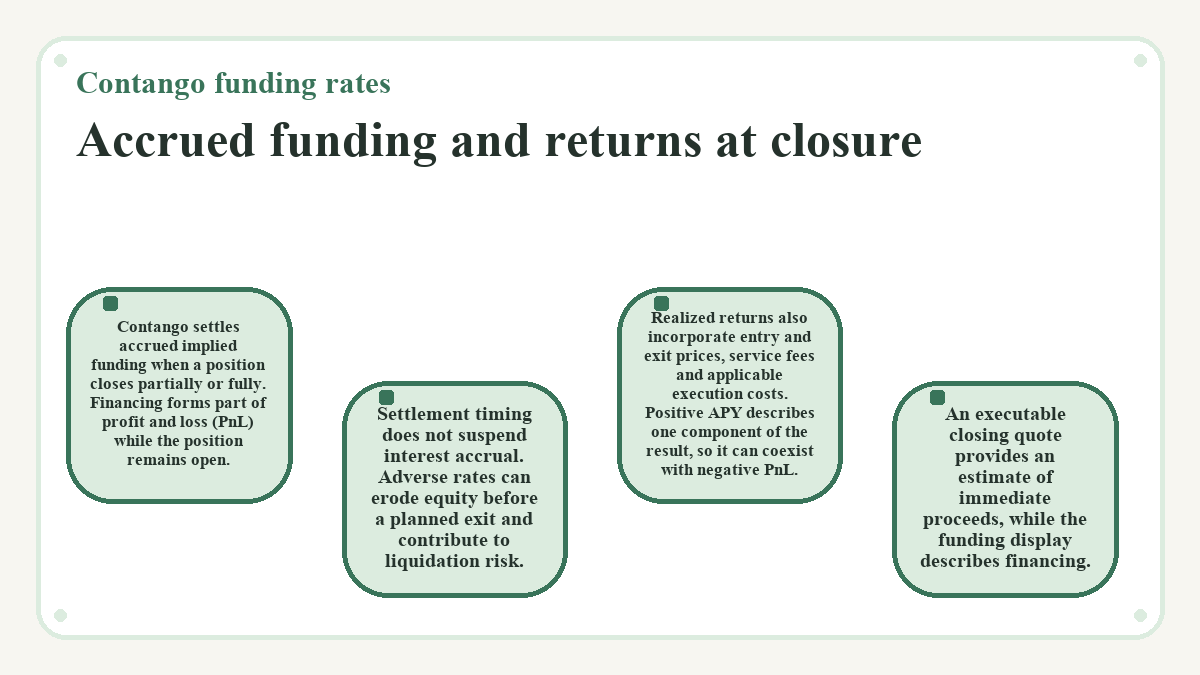
Contango settles accrued implied funding when a position closes partially or fully. Financing forms part of profit and loss (PnL) while the position remains open. Settlement timing does not suspend interest accrual. Adverse rates can erode equity before a planned exit and contribute to liquidation risk. Realized returns also incorporate entry and exit prices, service fees and applicable execution costs. Positive APY describes one component of the result, so it can coexist with negative PnL. An executable closing quote provides an estimate of immediate proceeds, while the funding display describes financing.
Money-market funding and periodic perp payments
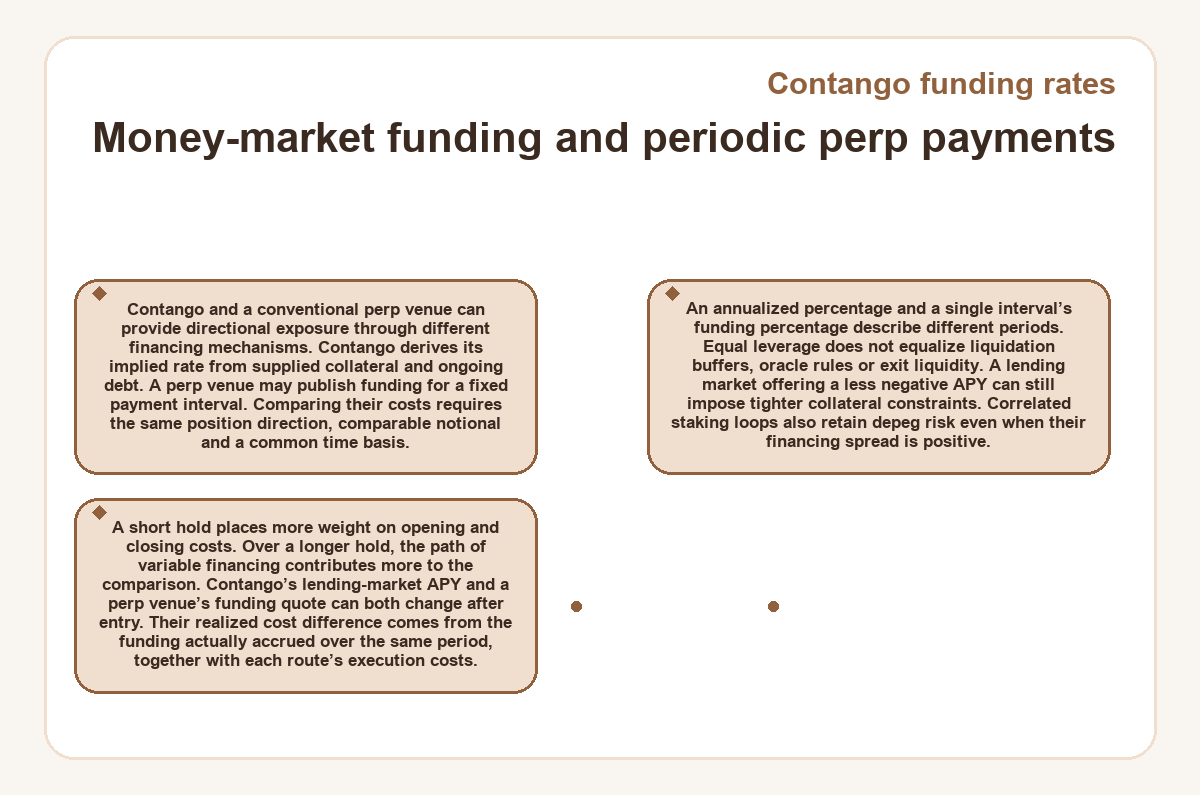
Contango and a conventional perp venue can provide directional exposure through different financing mechanisms. Contango derives its implied rate from supplied collateral and ongoing debt. A perp venue may publish funding for a fixed payment interval. Comparing their costs requires the same position direction, comparable notional and a common time basis. An annualized percentage and a single interval’s funding percentage describe different periods.
Equal leverage does not equalize liquidation buffers, oracle rules or exit liquidity. A lending market offering a less negative APY can still impose tighter collateral constraints. Correlated staking loops also retain depeg risk even when their financing spread is positive. A short hold places more weight on opening and closing costs. Over a longer hold, the path of variable financing contributes more to the comparison. Contango’s lending-market APY and a perp venue’s funding quote can both change after entry. Their realized cost difference comes from the funding actually accrued over the same period, together with each route’s execution costs.
FAQ
Can both sides of a hedged trade show positive Contango APY?
Opposite exposures can both show positive APY across different markets when each position’s lending income exceeds its borrowing costs. The condition depends on the pair, direction, lending market and chain. Positive APY on one side does not establish the other side’s rate. Offsetting price exposure also leaves financing and liquidation risks on both positions.
Is a PT’s fixed yield the same as its money-market supply APY?
A Principal Token (PT) normally earns no separate money-market supply interest; its purchase discount creates the gross return targeted at maturity under normal redemption conditions. The position still borrows at a variable rate, so its fixed-yield component does not fix the net return. Early-sale prices and impaired redemption conditions can also change the outcome.
Does switching the PnL price source alter the underlying funding rate?
Changing the displayed PnL price source changes valuation, not the underlying lending and borrowing terms. Money Market Oracle and DEX Spot Market can value the same position differently. A change in displayed PnL after switching sources therefore does not, by itself, establish a change in accrued funding.
Are third-party rewards automatically compounded into funding APY?
Contango does not automatically compound third-party rewards into the position’s funding APY. Reward yields appear separately as additional incentives, and claim arrangements vary by underlying protocol. Comparing base funding with a combined funding-and-reward figure mixes different components. A reward’s displayed annualized yield also does not establish when it becomes claimable.
How is sUSDe’s bearing yield estimated for a funding quote?
Contango estimates sUSDe’s bearing yield by annualizing its price change over the last 300 blocks. That observation window can produce a different estimate from an interface using another method. This asset-level yield input differs from the final position APY, which also reflects the position’s borrowing costs and leverage.
Can an open position move to a lower-cost lending market?
An existing position can migrate to another supported market when a compatible destination is available. The destination’s lending and borrowing conditions determine the new funding estimate, and its rate remains variable afterward. A lower borrowing rate alone does not establish a better net APY if the lending income also changes.