 Contango
 PT looping can support a maturity hold when yield covers borrowing and closing costs
Updated on
Contango PT looping fits a planned maturity exit when the PT’s purchase discount can cover financing and execution costs. The position uses Pendle Principal Tokens as collateral and borrows the quote asset at a variable rate. Holding until expiry can capture the purchase discount under normal redemption conditions. The trader also needs sufficient collateral throughout the loan and must close an open position manually at maturity. An early sale follows the available market price, so it can produce a different return.
Fixed PT yield and variable financing
The PT’s purchase discount creates the gross return targeted by a maturity hold under normal redemption conditions. Pendle separates principal from the asset’s variable yield, so the PT’s economics resemble a zero-coupon bond.
Borrowing increases the quantity of PT held and adds an ongoing financing bill. The PT normally earns no separate supply interest when deposited as collateral. Its return comes from redemption value relative to purchase price, while the quote-asset loan charges a variable rate.
Contango’s APY, or annual percentage yield, expresses the net rate against position notional. ROE, or return on equity, uses initial margin. Leverage makes those bases differ, which explains why an attractive ROE can coexist with a much smaller spread between asset yield and borrowing costs.
Entry estimates assume borrowing conditions persist on average. Actual entry price, sale or redemption proceeds, accumulated financing and trading costs determine the realized return.
Short maturities and annualized returns
A short remaining term gives opening spreads and closing costs less time to be offset by the PT discount. A temporary price drop can raise annualized yield while leaving a small return before maturity. Longer maturities spread trading costs across more holding time, while extending exposure to variable borrowing and collateral conditions. The useful comparison is the expected return over the remaining term after costs, using the quoted entry price.
Holding to maturity and selling early
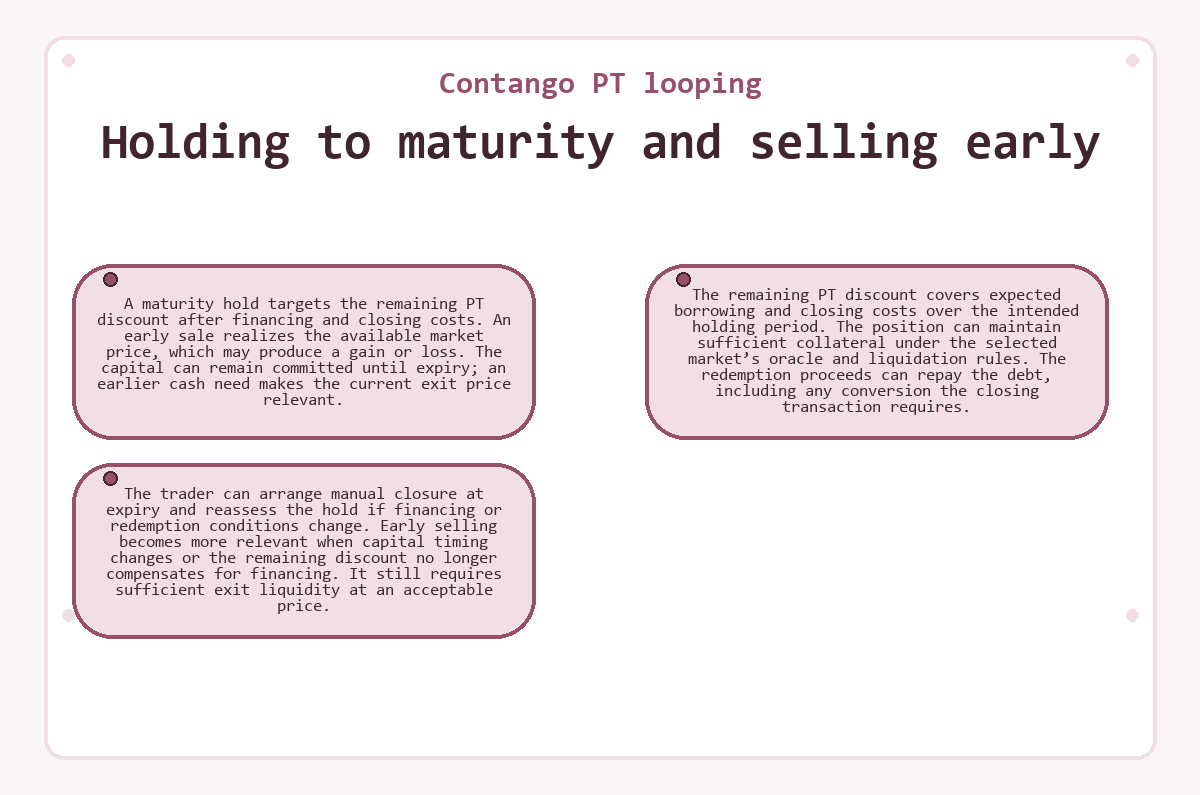
A maturity hold targets the remaining PT discount after financing and closing costs. An early sale realizes the available market price, which may produce a gain or loss.
- The capital can remain committed until expiry; an earlier cash need makes the current exit price relevant.
- The remaining PT discount covers expected borrowing and closing costs over the intended holding period.
- The position can maintain sufficient collateral under the selected market’s oracle and liquidation rules.
- The redemption proceeds can repay the debt, including any conversion the closing transaction requires.
- The trader can arrange manual closure at expiry and reassess the hold if financing or redemption conditions change.
Early selling becomes more relevant when capital timing changes or the remaining discount no longer compensates for financing. It still requires sufficient exit liquidity at an acceptable price.
The accounting asset behind redemption
Pendle’s accounting asset sets the unit of normal PT redemption. The asset in brackets in a market’s PT name identifies that accounting asset. Normal maturity redemption targets one unit of its value per PT.
For reward-bearing assets, redemption can deliver yield-bearing tokens worth the accounting amount. It does not promise one yield-bearing token per PT.
When redemption supplies the token owed, closing can redeem and repay without a spot swap. Different redemption proceeds require conversion to repay the loan. Any resulting price impact belongs in the expected maturity return. A different debt currency also exposes repayment to changes in the assets’ relative prices.
Pendle PT redemption can fall below normal value if the underlying interest-bearing token’s exchange rate against its accounting asset stays below its watermark. The watermark records the highest exchange rate between the interest-bearing token and its accounting asset. A lower redemption value changes the gross return the hold was meant to capture.
Collateral health before the planned exit
The lending market can liquidate a PT position before maturity when collateral no longer satisfies its rules. The underlying lending market uses its oracle valuation to determine a position’s liquidation eligibility. A market-price feed can reflect a temporary secondary-market decline. An exchange-rate feed follows a different valuation basis, so the same PT can face different liquidation behavior across markets.
Borrowing interest also increases the amount owed while the position remains open. Monitoring therefore concerns both the loan and the selected collateral valuation. The liquidation buffer indicates distance to the liquidation boundary. It cannot establish that a position will survive until redemption. Changing the displayed profit and loss (PnL) price source leaves the lending market’s collateral rules unchanged.
Debt changes when a maturity hold no longer fits
Extra capital enables debt repayment while retaining PT exposure. Contango’s Advanced interface supports reducing leverage through Modify. The trader supplies and authorizes any additional wallet funds needed for repayment. A smaller debt balance incurs less interest at the same borrowing rate.
Full debt repayment can allow withdrawal of the PT collateral. The PT then retains its own maturity and redemption conditions without that loan financing the holding. This alternative requires capital to repay the debt; waiting for a better sale price leaves borrowing costs running.
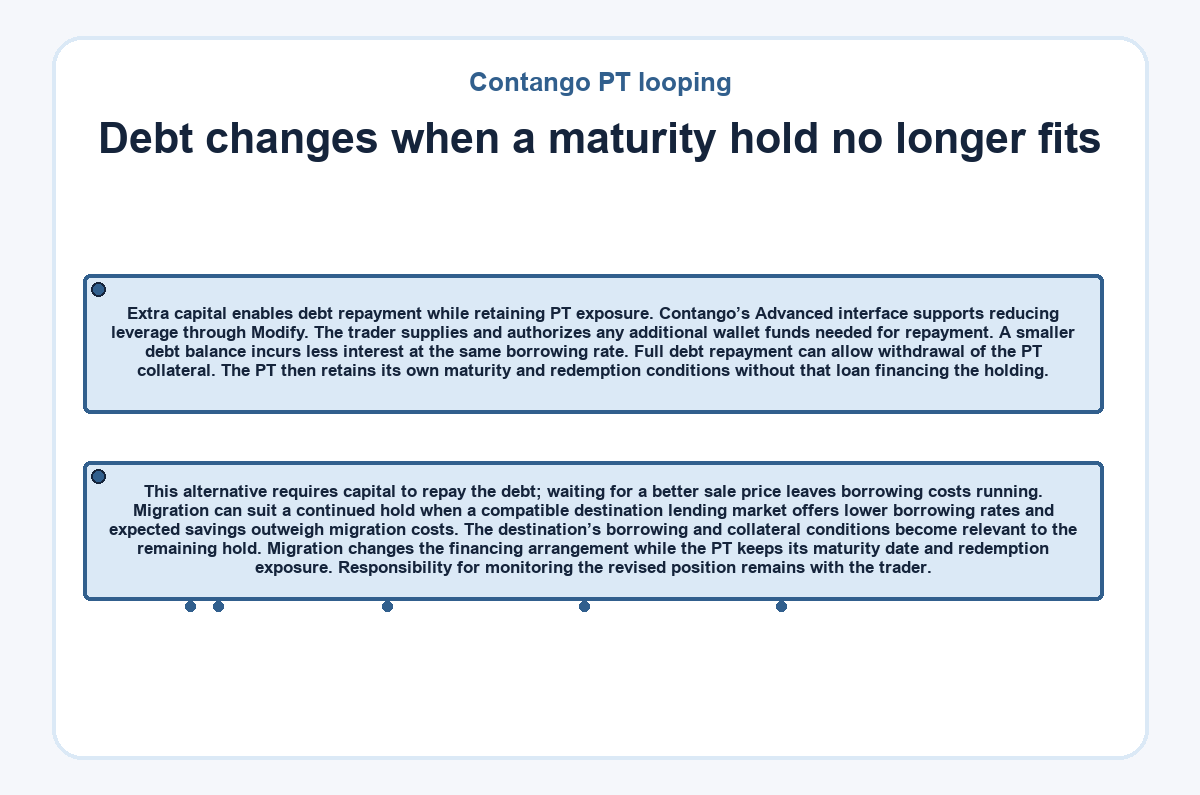
Migration can suit a continued hold when a compatible destination lending market offers lower borrowing rates and expected savings outweigh migration costs. The destination’s borrowing and collateral conditions become relevant to the remaining hold. Migration changes the financing arrangement while the PT keeps its maturity date and redemption exposure. Responsibility for monitoring the revised position remains with the trader.
Manual closure at maturity
PT expiry does not automatically close a Contango position. The trader initiates the maturity close. Contango redeems the matured PT assets and repays the outstanding debt, using conversion where the redemption proceeds require it. The current closing quote matters if a spot swap remains necessary.
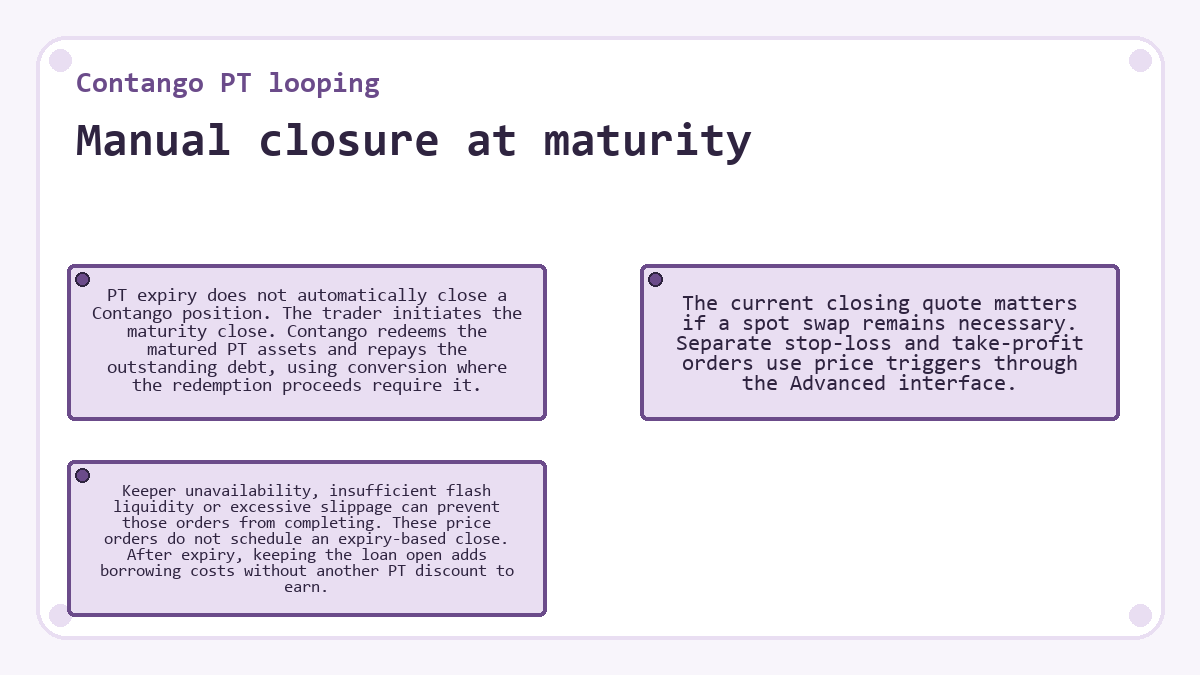
Separate stop-loss and take-profit orders use price triggers through the Advanced interface. Keeper unavailability, insufficient flash liquidity or excessive slippage can prevent those orders from completing. These price orders do not schedule an expiry-based close. After expiry, keeping the loan open adds borrowing costs without another PT discount to earn.
Contango PT looping: questions and answers
Can every listed PT serve as collateral for a maturity hold?
A PT listing alone does not establish an eligible looping pair. The token must support collateral use in the relevant lending configuration. The quote asset must also be available to borrow. Isolation mode or restrictions on collateral can prevent a pair. Supported instruments therefore depend on the lending market’s compatibility rules as well as its asset list. A PT’s maturity date does not override those restrictions.
Which margin currency avoids an extra conversion when opening a PT loop?
Using the selected PT or its quote currency avoids the additional margin conversion associated with a third supported token. Opening the leveraged position can still require a swap to acquire more PT. A different margin currency can introduce another conversion and another slippage constraint. At high leverage, those constraints can cause execution to fail, so the chosen margin asset affects whether the proposed position can be opened.
Does a PT loop receive the underlying asset’s points during the holding period?
Holding a Pendle PT does not entitle its holder to the underlying asset’s variable yield or points. Pendle assigns those benefits to Yield Token holders. A lending market may offer separate incentives for eligible collateral or borrowing activity, but those belong to a different program. A maturity-return estimate should therefore distinguish the PT’s purchase discount from any applicable lending incentive, without treating the underlying asset’s points as part of PT ownership.
How does a slippage limit affect a manual early PT exit?
For a manual early exit, the slippage limit constrains execution relative to the quote, while price impact already affects the quoted price. Selling a PT position uses available market liquidity, and trade size can worsen the quoted price. A tight tolerance can therefore accompany an unattractive exit quote. The quoted proceeds, remaining debt and accumulated costs determine whether an early sale delivers an acceptable return over the actual holding period.
Is a PT maturity date the same as expiry on Contango v1 futures?
A Pendle PT’s maturity and Contango v1 futures expiry belong to different instruments. Contango v1 used expirable futures and was discontinued in late 2023. A PT loop holds a token with its own redemption date while financing that exposure through a lending market. The token’s maturity does not establish the earlier futures product’s settlement mechanics or automatically repay the loop’s outstanding loan.